Guernsey
Gwernenez, Guernesey
49°27′N 2°34′W
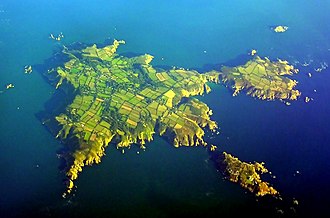
Guernsey ( GURN-zee; Guernésiais: Guernési) is the second-largest island in the Channel Islands, located 27 miles (43 km) west of the Cotentin Peninsula, Normandy.

Terrain
49°27′N 2°34′W
Overview
Guernsey ( GURN-zee; Guernésiais: Guernési) is the second-largest island in the Channel Islands, located 27 miles (43 km) west of the Cotentin Peninsula, Normandy. It is the largest island in the Bailiwick of Guernsey, which includes five other inhabited islands – Alderney, Herm, Jethou, Brecqhou and Sark – and many small islets and rocks. In 2023, the population of the island was 64,781. The land area of the island is 24 square miles (62 km2). Guernsey was part of the Duchy of Normandy until 1204, when the Channel Islands remained loyal to the English crown, splitting from mainland Normandy. In 1290, the Channel Islands were divided administratively and Guernsey became part of the Bailiwick of Guernsey. During the Second World War, Guernsey was invaded and occupied by Nazi Germany. After five years of occupation, the island was liberated on 9 May 1945, that date being celebrated annually as Liberation Day. Guernsey is administered as part of the Bailiwick of Guernsey, a self-governing dependency of the British Crown. The island is thus not part of the United Kingdom, although the UK government has certain responsibilities for the Bailiwick. The British monarch is the head of state and the head of government is the President of the Policy and Resources Committee. The jurisdiction's parliament and government is the States of Guernsey. The island is divided into ten parishes. It has one town, called Saint Peter Port. The government variously defines the position of the King of England as "Head of State" or "successor to the Duke of Normandy." Although no document explicitly defines the Head of State as a "monarch", or the islands as a monarchy, all documents refer to the king by royal titles. Guernsey's largest industry is financial services, followed by tourism and agriculture. The island is particularly well known for its cattle. Guernsey's culture is strongly influenced by Britain, evident in its use of the pound sterling and the status of English as the primary native language. Norman and French culture have also had an impact, such as with the island's traditional language, Guernésiais. French writer Victor Hugo spent fifteen years in exile in Guernsey, where he wrote some of his best-known works.
From Wikipedia, CC BY-SA 4.0
Chart
Nearest islands
Also in Channel Islands




Also in British Isles

Great Britain
218,685 km²▲ 1,345 m
Major islands

Ireland
83,553 km²▲ 1,039 m
Major islands

Lewis and Harris
2,149 km²▲ 799 m
Minor islands

Isle of Skye
1,636 km²▲ 992 m
Minor islands

Mainland
953 km²▲ 450 m
Minor islands

Isle of Mull
885 km²▲ 966 m
Minor islands

Anglesey
680 km²▲ 178 m
Minor islands

Islay
618 km²▲ 491 m
Minor islands
Photographs

Guernsey, Channel Islands

Guernsey, Channel Islands

Cobo Bay, Guernsey

La Grève, Guernsey

Cobo Bay, Guernsey

Braye du Valle, Guernsey

Braye du Valle, Guernsey

La Grève, Guernsey

A new building acquired and refurbished by Elizabeth College and opened in 2023, with the school's main building in the background

Richmond, Guernsey

Richmond, Guernsey

Vazon Bay, Guernsey
Sources
Facts
Photographs
- Guernsey, Channel Islands (49564882478). Andrew Milligan sumo / CC BY 2.0
- Guernsey, Channel Islands (49564882273). Andrew Milligan sumo / CC BY 2.0
- Cobo Bay, Guernsey (49557186958). Andrew Milligan sumo / CC BY 2.0
- La Grève, Guernsey (49562290981). Andrew Milligan sumo / CC BY 2.0
- Cobo Bay, Guernsey (49557181768). Andrew Milligan sumo / CC BY 2.0
- Braye du Valle, Guernsey (49557351303). Andrew Milligan sumo / CC BY 2.0
- Braye du Valle, Guernsey (49557352103). Andrew Milligan sumo / CC BY 2.0
- La Grève, Guernsey (49562291536). Andrew Milligan sumo / CC BY 2.0
- Perrot Court. Ave / CC0
- Richmond, Guernsey (49557325918). Andrew Milligan sumo / CC BY 2.0
- Richmond, Guernsey (49557822396). Andrew Milligan sumo / CC BY 2.0
- Vazon Bay, Guernsey (49557025983). Andrew Milligan sumo / CC BY 2.0